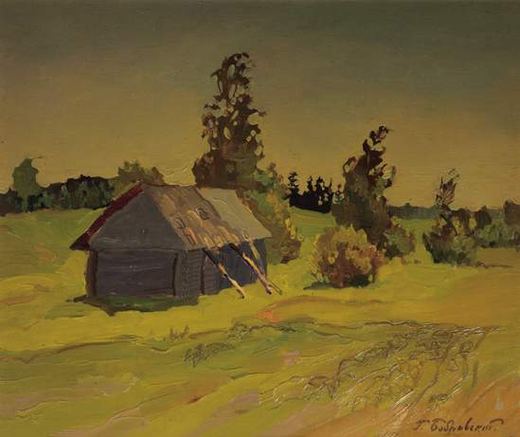
Haystack
Grigorij Michailowitsch Bobrowskij
Oil on wood panel · 29 x 25 cm
Grigory Mikhailovich Bobrovsky was a Russian-Soviet painter and teacher whose work connects the transitions between late academic Realism, the artists' association landscape around 1900 and Soviet art institutions. Born in 1873 in Vitebsk, he first received a seminary education before moving to Saint Petersburg and studying at the Higher Art School of the Imperial Academy of Arts. There he belonged to the environment of academically grounded, yet increasingly modern Russian painting around 1900. The Russian Museum presents Bobrovsky as an artist who participated in numerous exhibitions, including associations such as Mir Iskusstva and the Union of Russian Artists. This exhibition biography is important for his classification: Bobrovsky does not stand in isolation, but within a dense artistic network in which academic schooling, Impressionist interests in light, Symbolist sensitivity and realist observation existed side by side. Bobrovsky was not only a painter, but also a teacher. He taught at various art schools and later in Petrograd / grad in the institutions that emerged from the upheavals after the Revolution. His death in besieged grad in 1942 adds historical gravity to his oeuvre. It marks the dramatic rupture between the cultivated art world of the late Empire and the catastrophes of the twentieth century.
Bobrovsky's work comprises portraits, landscapes and genre-like compositions. Particularly important is his ability to combine academic solidity with freer painterly handling. His works reveal a generation that was not radically avant-garde, but moved painting around 1900 beyond a purely academic formula. Art-historical classification: Art-historically, Bobrovsky is interesting as a figure of mediation. He is neither an iconic avant-gardist like Malevich nor a pure nineteenth-century Realist, but an artist of transitions. His participation in different exhibition contexts shows the polyphony of Russian art around 1900: Realism, Impressionism, Symbolism and decorative modernity were not separate worlds, but stood in productive tension.
For I tesori della Russia, Bobrovsky is particularly well suited to communicating the artistic complexity of the period around 1900. He shows that Russian art does not consist only of clearly separated movements, but also of transitional figures who combine several aesthetic languages. His collection relevance is supported by the naming of important Russian and regional museums. In a public catalogue, he is represented as a cultivated painter and teacher whose work mediates between Academy, artists' associations and Soviet art education.