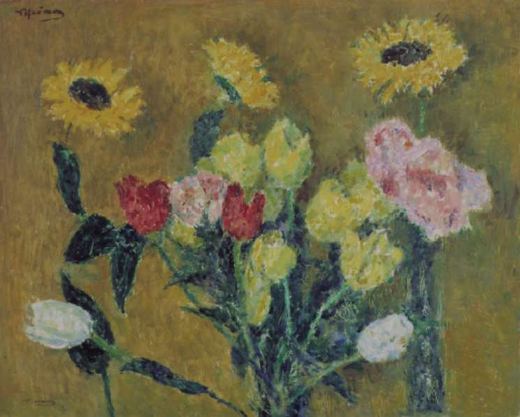
Flowers and Sunflowers
Grigory Izrailevich Tseitlin / Grigori Tseitlin
1996 · Oil on plywood · 60 x 48 cm
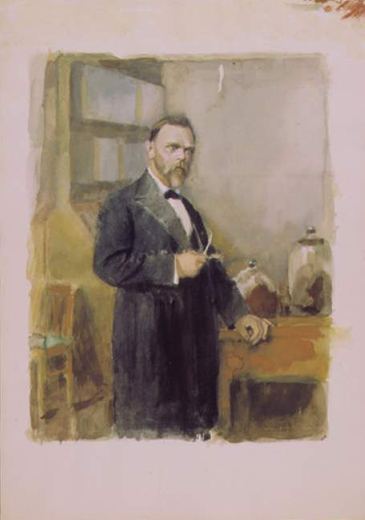
Grigory Izrailevich Tseitlin is a representative of the older generation of the Moscow School and an artist whose work preserves the dignity of portraiture, the quiet concentration of still life and the human dimension of Soviet realisms. He is not among the loudest names of the twentieth century, yet his art has a particular value for collections: it stands for painterly continuity within an era often narrated either through the Avant-Garde or through ideology. Tseitlin was born in 1911 in Chernyovka in the Mogilev Governorate, a region that today leads into Belarusian and broader Eastern European cultural history. In 1932 he graduated from the Odessa Art Institute. According to the Virtual Russian Museum, his teachers included A. Shovkunenko, D. Krainev, A. Gausch and T. Fraerman.
Like Gurvich, Tseitlin was thus rooted in the Odessa training milieu, which combined colour, solid painterly technique and a particular openness to southern light and form culture. He later became a Moscow artist. The Russian Museum describes him as a painter and portraitist, as well as a representative of the older generation of the Moscow School. He was a member of the Soviet Union of Artists, later of the Professional Union of Artists of Russia, and was awarded the title Honoured Artist of the RSFSR. His biography was also shaped by the Second World War; he was a participant and veteran of the war. This experience forms an unspoken historical background for many artists of his generation. Tseitlin's work includes portraits, still lifes, landscapes and figural scenes.
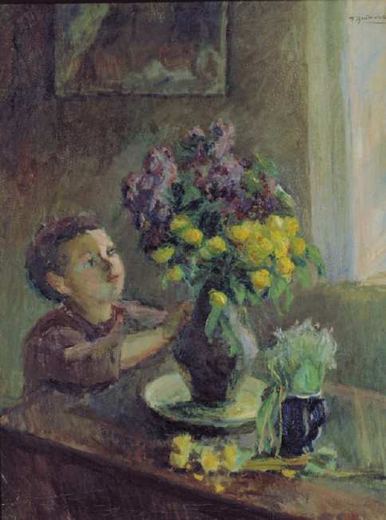
While the large political programmes of Soviet art often relied on heroic narrative, what is especially important in Tseitlin is human proximity. His portraits are not merely images of representation, but seek character, bearing and inner composure. Still lifes and interiors show a painterly culture in which colour, materiality and light create a restrained but stable pictorial order. Art-historically, Tseitlin is understood as a representative of a moderate, technically grounded realism. His art does not stand outside Soviet art history, but neither is it reducible to its ideological surface. In his work, painting remains a language of perception, dignity and everyday humanism. Precisely this quality makes him interesting for a collection that seeks not only spectacular stylistic ruptures, but also cultural depth.
Tseitlin's visual language is marked by painterly solidity. Portraits, figure paintings and still lifes are calmly constructed, chromatically balanced and oriented toward presence. Form is not broken apart, but gathered. Light does not serve dramatic effect, but concentration on the object or person. In many works there is a sense of character that is psychological rather than theatrical. Within the context of the Moscow School, Tseitlin stands for a realist art that upholds craft, quality and human observation. His painting may be read as a counterpoint to the extremes of the Avant-Garde and to schematic state art: it is serious, representational, culturally sustaining and turned toward the individual.
For I tesori della Russia, Tseitlin represents cultivated Soviet painting of the Moscow School. He adds to the collection a position that makes visible the long afterlife of the academic and realist tradition in the twentieth century. Together with Gurvich and Klimenko, Tseitlin makes it possible to present Soviet art not as monolithic, but as a field of different regional, painterly and biographical experiences. His distribution in major and regional museums, as well as in international private collections as named in the source list, makes him plausible as a collection position. For an elevated audience, the text focuses on quality, portrait culture and the Moscow School, not on name recognition alone.