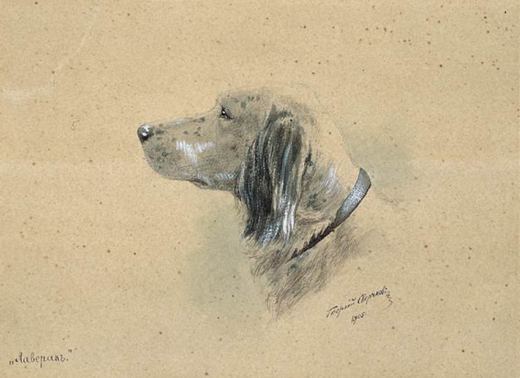
The Laverack Dog
Georgy Nikolaevich Sverchkov / Sverchkoff
1905 · Pencil and pastel on paper · 24 x 16 cm
Georgy Nikolaevich Sverchkov was a painter and graphic artist belonging to a distinctive line within Russian art: the highly developed representation of horses, hunting and animals. He was born in 1872 in Tsarskoye Selo near Saint Petersburg and died in Paris in 1957. His artistic background is directly linked to his father, Nikolai Egorovich Sverchkov, a well-known academician and master of hunting, riding and troika scenes. This family connection was not merely biographical; it shaped the core of his artistic vision. Sverchkov grew up in a milieu in which the horse, the rider, military elegance, hunting culture and aristocratic forms of movement were not only motifs, but social signs. He was himself familiar with horses, was considered a skilled rider and maintained a racing stable. This practical knowledge distinguishes his depiction of horses from purely studio-based animal painting.
His horses do not appear as decorative attributes, but as living bodies with weight, temperament, tension and social meaning. After the Revolution, Sverchkov belongs to those artists whose work must also be read in the context of Russian emigration. His death in Paris points to the displacement of Russian art centres after 1917. Many artists, collectors and art-trade networks moved abroad, while motifs of old Russia - cavalry, hunting, nobility, horse breeding, imperial culture - acquired a new meaning in exile. They were preserved not only nostalgically, but also as cultural memory. Sverchkov's subject matter therefore opens a world that is crucial for understanding pre-revolutionary Russian visual culture: the relationship between horse and human being, between estate culture and military identity, between aristocratic representation and technical knowledge of the animal body.
His work is read at the intersection of animal painting, social history and emigre memory. For an international public, the artist is also useful because equestrian and hunting imagery is immediately readable yet historically layered. It offers an entry into a cultural field that is often overshadowed by landscape, icon, avant-garde and Socialist Realism.
Sverchkov's work is distinguished by close observation of posture, movement and breed characteristics. His horses are not schematised; they are shown through a combination of anatomical assurance and narrative setting. Line is decisive for capturing movement, while the compositions remain close to genre painting because horse, human figure, landscape and social situation remain connected. Art-historically, Sverchkov belongs to the afterlife of academic-realist animal painting and to the Russian emigre context. While the avant-garde often fragmented the horse dynamically and Soviet Realism later integrated it into iconographies of labour and war, Sverchkov preserves an older aristocratic riding culture. That makes his work valuable for I tesori della Russia: it recalls pictorial worlds that were historically interrupted by revolution and exile.
In I tesori della Russia, Sverchkov can represent the collection field of Russian animal and equestrian painting. He expands the collection by adding a cultural-historical dimension: Russia as a world of cavalry, hunting, studs and the symbolic relationship between human being and horse. For a sophisticated audience, this perspective is particularly interesting because it brings together art history, social history and emigration history.