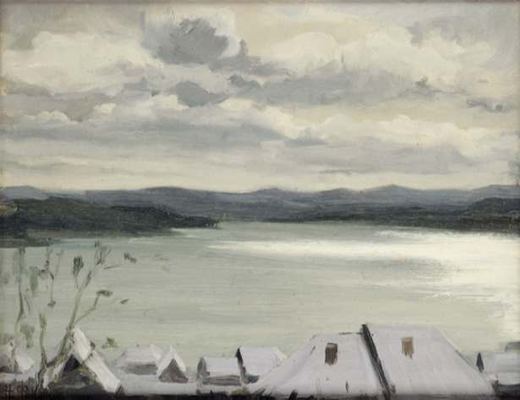
Snow-Covered Village along the River
Nikolai Mikhailovich Fokin
Oil on wood panel · 37 x 29 cm
Nikolai Mikhailovich Fokin belongs to the generation of Russian landscape painters around 1900 whose work stands between academic training, realistic observation of nature and an increasingly lyrical conception of landscape. He is not one of the most loudly canonical names of Russian art, yet his profile is important precisely because it shows the breadth and refinement of landscape painting in the late imperial period. Fokin represents a quieter strand of Russian art: attentive observation, cultivated composition, sensitivity to mood and a serious interest in the ordinary appearance of nature. Born in Saint Petersburg, Fokin received his artistic training at the Imperial Academy of Arts, where he studied in the 1890s with Alexander Kiselev. The Academy gave him a secure command of composition, drawing and painterly construction.
Kiselev, himself an important landscape painter and teacher, was a particularly significant influence because he represented a balanced form of landscape art: academically grounded, but open to atmosphere, travel impressions and emotional response to nature. Fokin's connection with artists' associations at the turn of the century is also important. He was active in the environment of academy exhibitions and the New Society of Artists; journeys and stays in Germany, Italy, France and Finland broadened his visual horizon. This international experience did not turn him into a cosmopolitan modernist in the radical sense, but it sharpened his feeling for light, air and the changing character of landscape. In his work, Russian natural motifs and a broader European pictorial culture meet without theatrical emphasis.
Fokin spent his final years partly in Mustamäki in Finland, a place that, for many artists of the Petersburg cultural world, combined retreat, landscape experience and a sense of climatic and psychological distance from the metropolis. This northern or Finnish dimension adds a particular tone to his profile. His landscape art is understood as a form of cultivated looking: not heroic nature, not symbolic drama, but the quiet concentration of atmosphere and place.
Fokin's work is characterised by the union of academically ordered pictorial structure and lyrical mood. His landscapes are based on careful observation of nature, yet they avoid excessive topographical detail. The motif becomes a carrier of light, air and calm. Composition remains controlled, but the visual effect depends strongly on atmosphere. Art-historically, Fokin stands in the aftermath of the great Russian landscape school of Shishkin, Levitan, Dubovskoy and Kiselev. He does not occupy their canonical rank, but his position is instructive because it shows how the achievements of Russian landscape painting were continued by a wider generation of trained, exhibition-active artists. His work belongs to the cultivated middle field between academic landscape, Realism and lyrical nature study.
For I tesori della Russia, Fokin is important because he expands the view of the quieter but art-historically revealing layers of Russian landscape painting. Alongside the major names, he shows that the collection is not interested only in peak canonical positions, but also in the differentiated visual culture around them. A Fokin profile gives the collection greater depth in the field of Russian landscape around 1900 and supports a nuanced narrative of school, academy, travel and atmosphere.