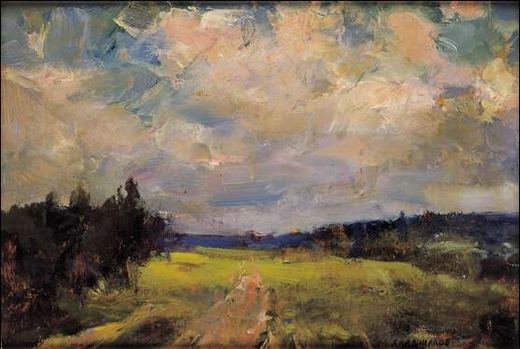
Clearing in the Forest
Manuil / Emmanuel Khristoforovich Aladzhalov
Oil on cardboard · 25 x 17 cm
Manuil Khristoforovich Aladzhalov was an Armenian-Russian landscape painter and graphic artist whose work belongs to the tradition of the Moscow landscape school. Born in 1862 in Nakhichevan-on-Don near Rostov, he received his initial artistic training in Rostov and then at the Moscow School of Painting, Sculpture and Architecture. There he encountered teachers central to Russian landscape painting in the nineteenth century, including Alexei Savrasov, Isaac Levitan, Vasily Makovsky and Illarion Pryanishnikov. This training shaped Aladzhalov's artistic outlook in a lasting way. He did not develop a revolutionary pictorial language; rather, he pursued a cultivated landscape art rooted in close observation of nature, mood and lyrical measure.
His art follows the line in which Russian landscape is not conceived as a heroic stage, but as an emotional field of resonance: forests, rivers, thawing snow, fields, paths and transitional states of weather become carriers of quiet and often melancholic perception. Aladzhalov participated in numerous exhibitions and moved within several artistic associations, including the Moscow artistic milieu, the Peredvizhniki tradition, the Union of Russian Artists and later Soviet realist organisations. His teaching activity was equally important. He taught, among other places, at the Stroganov School and helped transmit the Moscow landscape tradition into the twentieth century.
Aladzhalov's landscapes are marked by restraint, quiet tonality and careful observation of nature. Motifs of spring, thaw, river landscape and Russian provincial scenery are especially characteristic. Light is not dramatic, but atmospheric; the pictorial space often opens through soft transitions, creating an impression of stillness and extended time. His painting stands close to Levitan without simply copying Levitan's metaphysical intensity. Aladzhalov is interested in the modest, recognisable Russian landscape in which nature and everyday life appear without pathos. This quality makes him relevant for collectors and art-historically informed viewers: he demonstrates the continuation of lyrical Realism in a period increasingly shaped by modernism, Symbolism and, later, Soviet pictorial programmes. Art-historical classification: Art-historically, Aladzhalov mediates between the great landscape tradition of the nineteenth century and the realist landscape painting of the early twentieth century. His works are represented in the Tretyakov Gallery and in numerous regional museums in Russia. He is therefore significant not only as an individual artist, but also as a bearer of a well-established museum tradition of landscape art.
For I tesori della Russia, Aladzhalov is a valuable position because he represents the lyrical landscape line of Russian art. Alongside better-known names such as Levitan, Shishkin or Dubovskoy, he allows a finer gradation: the collection can show how Russian landscape art continued not only through the masterpieces of major schools, but also through sensitive, regionally and pedagogically influential artistic biographies.