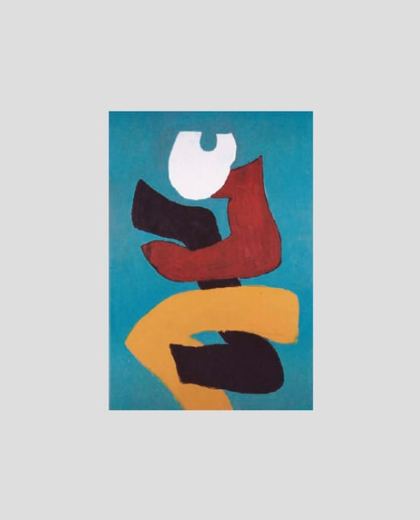
Guitarist
Ely Bielutin; Eliy Mikhailovich Belyutin
Oil on canvas · 100 x 150 cm
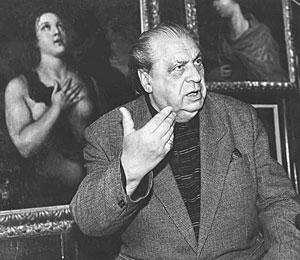
Elij Michailowitsch Beljutin is one of the central figures of unofficial Soviet art after Stalin. He was a painter, art theorist, teacher, founder of the group and school New Reality, and a key figure within an artistic movement that challenged the narrow prescriptions of Socialist Realism without standing entirely outside the Soviet cultural sphere. His importance therefore lies not only in his own work, but also in his role as organizer, teacher and mediator of an alternative artistic practice. Beljutin studied in Moscow and developed an early interest in modern art, abstract form and experimental perception. His pedagogy did not aim at mere academic imitation, but at the release of individual artistic perception. With New Reality he created a space in which artists could search for abstract, expressive and symbolic modes of expression.
This school became an important point of reference for Soviet nonconformist art. Beljutin's connection with the Manege exhibition of 1962 is historically decisive. There Nikita Khrushchev reacted publicly and sharply against abstract and experimental art. The event became a symbolic rupture in Soviet cultural policy. Beljutin has since stood for the tension between state control of art and artistic self-determination during the Thaw. The Tretyakov Gallery honoured Beljutin in 2025 with an expanded presentation for the artist's hundredth birthday and described him as the founder of New Reality, a creative association of artists who sought free creativity and experiment. His museological re-evaluation is therefore clearly visible.
For a collection of Russian art, Beljutin is indispensable if the twentieth century is to be told not only as a history of official art, but also as a history of experiment, conflict and intellectual self-assertion.
Beljutin's work moves between abstract expression, symbolic condensation and a later, more schematic and sign-like pictorial language. Colour, gesture and sign do not serve external description, but make inner dynamics visible. The picture plane becomes a field of psychic, energetic and structural relations. Art-historically, Beljutin belongs to the context of Soviet nonconformism, but he must also be understood as a teacher and theorist. His significance lies in his conception of art as a method of perception and free thought. In this respect he stands in a line with the Russian avant-garde without simply repeating it: he transferred the problem of artistic freedom into the political and institutional conditions of the post-war Soviet Union.
The source list names the Tretyakov Gallery, Moscow centres for contemporary art, the Russian Museum and museum contexts connected with Soviet nonconformist art. For I tesori della Russia, Beljutin is a key position of the later twentieth century. He adds to the collection the struggle for abstraction and artistic freedom after the end of the classical avant-garde. Beljutin connects avant-garde inheritance, Soviet cultural policy, pedagogical experiment and renewed recognition in contemporary museums.