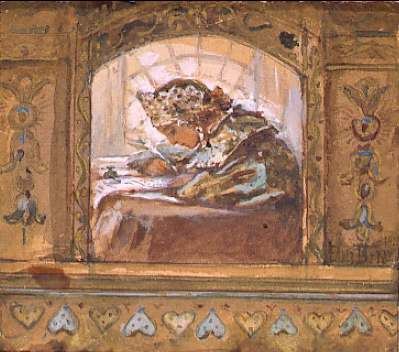
The Little Princess Writing
Elisabeth Boehm / Elizaveta Merkuryevna Bem
1900 · Watercolor and porporina on paper · 9 x 8 cm
Elizaveta Merkuryevna Bem, internationally often known as Elisabeth Böhm or Boehm, is an outstanding representative of Russian graphic art and illustration in the late nineteenth and early twentieth centuries. Her work belongs to a field that is sometimes underestimated in grand narratives of art history: silhouettes, book illustration, children's images, postcards and applied graphic culture. Yet precisely these media made her one of the most widely visible Russian artists of her time. Bem was born in Saint Petersburg in 1843 into the Endaurova family and spent an important part of her childhood on the family estate in the Yaroslavl province. This early experience of rural life, children, folk customs and everyday observation later became central to her imagery.
She studied at the Drawing School of the Society for the Encouragement of the Arts and was trained in drawing and graphic discipline. Her artistic language developed not through monumental painting, but through reduction, contour and narrative economy. She became especially famous for her silhouettes. In albums such as Silhouettes and Silhouettes from the Life of Children, she created a form in which reduced outline, childish gesture, folk motifs and fine humour are combined. The silhouette became an independent artistic language in her hands. It is not merely a decorative shadow image, but a compact narrative sign. A lifted arm, a small profile, a dress, a toy or an animal can be enough to suggest an entire scene. In the early twentieth century, Bem became one of the most popular Russian postcard artists.
She produced hundreds of postcards, often with child figures, proverbs, greetings and folk-cultural motifs. In these works, image and text form a visually memorable unit. Their popularity is not mistaken for lack of artistic value. Bem's postcards are important documents of Russian visual culture, literacy, children's imagery, national motif and the emergence of modern mass reproduction. Her significance also lies in the visibility of a female position in Russian art that did not depend on academic monumental painting, but on illustration, print, children's culture and applied art. Bem shows that the history of Russian art must include domestic visual worlds, popular media and the circulation of images in everyday life. For a high-quality collection profile, her art is therefore presented not as minor craft, but as a refined graphic culture with broad social reach.
Bem's visual language is marked by contour, rhythm and narrative economy. In the silhouettes, every detail is reduced to its necessary expressive function. Children, animals, rural scenes and folk motifs appear through profile, gesture and movement. This makes her work both easily readable and formally disciplined. In the postcards, Bem connects image and text to create an early form of cultural mass communication. Her works are important for the history of Russian graphic art, children's illustration and the visual culture of everyday life. They stand at the intersection of popular culture, Art Nouveau taste, folk imagery and refined drawing.
For I tesori della Russia, Bem is especially valuable because she opens the collection to the world of Russian book and applied graphic art. She shows that Russian art is not present only in large canvases, academic landscapes or avant-garde manifestos, but also in silhouettes, children's images, postcards and printed objects. Her presence strengthens the collection's cultural breadth and makes visible a female artist whose work reached a wide public while retaining artistic distinction.