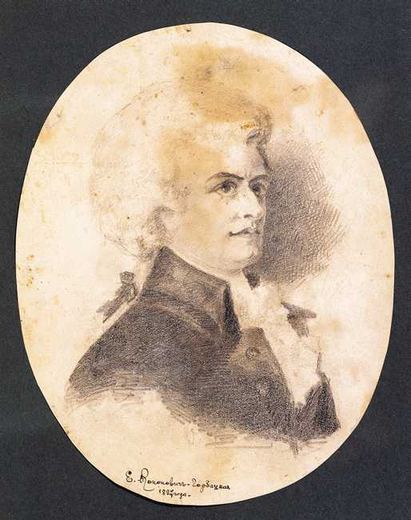
E. Kononovich-Gorbatskaya
1897 · Pencil on paper · 15 x 19 x 0 cm
The entry “E. Kononovich-Gorbatskaya” is treated with special caution in a professional art catalogue. On the present source base, no clearly documented artist-person with this name can be securely identified. The source file gives the name in the form “Кононович-Горбацкая Е.” and places beside it the year 1910, while also noting that no clearly documented artist-person is known. A high-quality collection record does not conceal this finding, but present it transparently and in a scholarly manner. Names of this kind create a typical problem in Russian and Eastern European holdings. Signatures, inventory notes, print information, owner marks, editor names or bibliographic references may later be misread as artist names. The year 1910 may be a date of creation, publication year, acquisition mark or another documentary reference. In fact, references exist to an “E.
Kononovich-Gorbatskaya” as editor or compiler of a Russian chrestomathy from 1910, but not as a clearly verified visual artist. This trace proves no identity with the collection object, but it explains why a premature artist biography would be problematic. For public presentation, the name is therefore not supplemented with invented life dates, a constructed nationality or a stylistic attribution. In the higher-level art and collection context, an honest designation as “attribution under review” is more professional than an apparently complete but unsupported biography. International collectors, curators and provenance researchers recognise such distinctions as a mark of quality. A catalogue that differentiates between secure artist profiles and open attributions appears more credible than one that hides gaps. Nevertheless, the entry can be treated in a curatorial and meaningful way.
It points to the collection-historical reality that art holdings consist not only of canonical names but also of works with incomplete or problematic authorship. Such objects are not without value; they simply require another mode of cataloguing. In these cases, material, technique, motif, provenance, signature form and comparative works move to the foreground. Only once these levels have been examined can it be decided whether “Kononovich-Gorbatskaya” denotes an artist, a commissioner, an owner, an editor or an erroneous transcription. For I tesori della Russia, this profile is therefore maintained as a professional research-status record. Publicly, a brief note may state that the artist attribution is currently under review.
Internally, a dedicated verification loop follow: high-resolution signature photograph, reverse inscriptions, frame analysis, paper or canvas analysis, comparison with auction records, Russian library catalogues, archival holdings and possible name variants. Only after this a decision be made about whether to create a full artist profile.
The character of the work cannot be described responsibly without a secured object and without an unambiguously identified artist-person. Any stylistic statements would currently be speculative. A professional approach is therefore to catalogue the item primarily at object level rather than person level: technique, dimensions, motif, signature, date, provenance and comparison group take priority. Art-historically, the entry is relevant as an example of an open attribution. It demonstrates the need for a data-quality standard within the collection: verified artists, attributed artists, workshop or circle designations and unidentified signatures must be kept clearly separate.
For I tesori della Russia, this entry is a test case for the quality of the collection documentation. An ambitious public catalogue show that it does not overwrite uncertainty with false certainty. The provisional value of the entry lies in its documentary function: it makes visible where further provenance and signature research is necessary. This transparency strengthens the credibility of the entire collection.