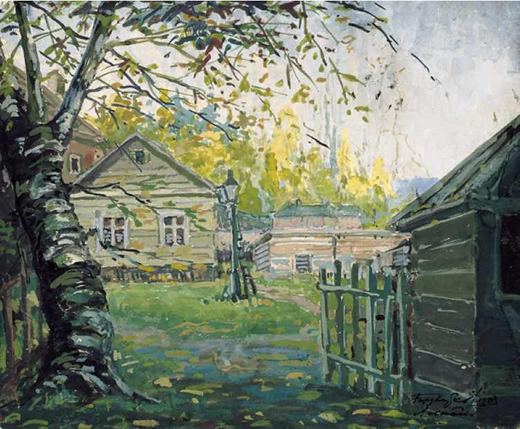
The Park of Lesnoye near Saint Petersburg
Boris Ivanovich Tsvetkov
1903 · Tempera on cardboard · 21 x 18 cm
Boris Ivanovich Tsvetkov belongs to the generation of Russian artists whose work developed between the end of imperial art education and the formation of a new Soviet visual culture. Sources give slightly varying life dates - most often 1893/1895 to 1942/1943 - but his art-historical position can be defined with sufficient clarity: Tsvetkov was a painter, theatre artist and decorator, trained in the Petersburg milieu and active in the 1920s and 1930s, a period in which art, stage design, exhibition practice and the public image were radically reorganised. His training took place in the private art school or studio of Aleksandr Makovsky in Saint Petersburg; further work under Professor V. Kurye is recorded for the years 1915-1918.
Tsvetkov later participated in several artists' associations, including the Community of Artists, the Society of Individualist Artists and the artists' society named after Arkhip Kuindzhi. These memberships are important for his classification: they show him not as an isolated decorator, but as a participant in the plural and today often underestimated grad art scene, where academic, decorative, realist and experimental tendencies overlapped. Tsvetkov's work in theatre and decorative design is of particular significance. In the early Soviet state, theatre was a central field of experimentation. Stage set, space, light, construction and movement became carriers of new aesthetic and social ideas. Tsvetkov's activity as a theatre artist between 1921 and 1925 connects him with this milieu, even if his surviving oeuvre is more narrowly documented than that of the famous avant-gardists.
Works preserved or recorded in museums, including the 1932 painting “Heated Basin and Log Conveyors” listed by the Russian Museum, also show his interest in industry, infrastructure and the modern Soviet sphere of labour. This places him in an important intermediate field: between artistic experiment and the more recognisable, object-based imagery of Soviet modernisation. For a collection of Russian art, Tsvetkov is valuable precisely because he is not a canonical star name. His profile helps document the breadth of production between avant-garde and official state art - the zone in which many artists actually shaped the visual language of the new society.
Tsvetkov's pictorial world moves between decorative organisation of the surface and representational sobriety. Unlike the heroic monumentality of later Socialist Realism, his painting seems to think more from the interaction of stage, technical world and compositional construction. Motifs of aviation, fleet, production and public life refer to the visual horizon of the 1930s, when technical modernisation and collective labour became central subjects of Soviet art. Art-historically, Tsvetkov represents the transition from Petersburg-grad artists' association culture into Soviet exhibition and theatre practice. His work demonstrates how painting, applied art, stage design and technical modernity were interwoven in the 1920s and 1930s. For I tesori della Russia, he is therefore not only interesting as an individual artist, but as a representative of a historical field less prominently treated than either avant-garde or academy.
Within I tesori della Russia, Tsvetkov can strengthen the collection strand of early Soviet visual culture. His profile is especially useful where a work touches on industry, theatre, decorative composition or the modern Soviet world of labour. Through him, the collection can show that Russian art of the twentieth century cannot be reduced either to abstract avant-garde or to representative realism.