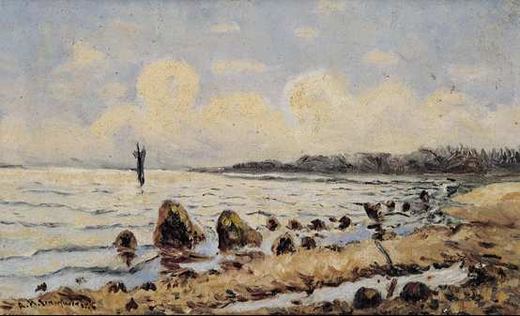
Gulf of Finland
Arturs / Arthur Yanovich Baumanis
Oil on canvas · 20 x 13 cm
Arthur Yanovich Baumanis is an artist of the Baltic-Russian borderlands whose profile is treated with particular source-critical care. The person listed in the collection is not confused with the older Latvian history painter Arturs Baumanis (1867-1904). According to the available art-market and gallery references, the entry refers instead to a painter and theatre artist born around 1892, who worked within the sphere of Latvian and Russian-influenced art education in the early twentieth century. His significance lies less in an internationally canonised career than in his mediation between Petersburg training, the Baltic art landscape and regional teaching practice. According to the available information, Baumanis was born in or near Mitau/Jelgava in Latvia and studied between 1912 and 1916 at the Saint Petersburg Academy of Applied Arts, or Baron Stieglitz School.
This institution was highly important for artists from the Baltic provinces. It combined academic drawing discipline, applied art, decorative design and a European-oriented formal education. In Baumanis's case, this means that his work is understood within the wider field of Russian-Baltic artistic relations rather than in a purely national isolation. Baumanis is described as a painter and theatre artist. He also worked for decades as a teacher at the Liepaja School of Applied Arts. This pedagogical dimension is central to his art-historical classification. In regional art centres such as Liepaja, modern art was not carried only by museums and exhibitions, but also by professional schools, theatre workshops, applied art and the transmission of craft skills. Baumanis therefore represents a layer of Baltic art culture in which painting, stage and education were closely connected.
His known works appear mainly as landscapes and atmospheric motifs. The collection and market references point to oil painting, landscape subjects and maritime or regional themes. This subject world corresponds to a Latvian-Baltic artistic tradition in which landscape, coast, light and rural architecture were central concerns. For a Russian collection this is not peripheral, but revealing. Russian art history of the nineteenth and early twentieth centuries was imperial, multilingual and regionally complex. Artists from Latvia, Lithuania, Belarus, Poland, Ukraine and the Caucasus moved through institutions radiating from Saint Petersburg and Moscow, while also developing local visual languages of their own. Baumanis is therefore not presented in I tesori della Russia as a major canonical Russian master.
He is better understood as a representative of a Baltic-Russian marginal and exchange space. Such a classification is more demanding and more honest. It shows that the collection seeks to make visible not only the well-known centres, but also the complex cultural geography of the former Russian Empire and the early Soviet period.
On the current source base, Baumanis's work is accessible above all through gallery and auction references. He is listed as a painter and theatre artist; preserved or traded works show landscapes and atmospheric scenes. The character of the work is therefore not overstated. A plausible classification is regional Baltic painting of the twentieth century, connected with landscape, applied art and theatre design. Art-historically, Baumanis is relevant above all as an example of the effect of the Stieglitz School on Baltic artists. The school transmitted a professional design education in which painting, decorative art and applied form culture were linked. Baumanis's profile makes clear how strongly Russian art institutions extended their influence beyond the centre.
For I tesori della Russia, Baumanis can strengthen the Baltic dimension of the collection. He allows for a nuanced presentation of artists who do not belong to the narrow Russian canon, but are connected to Russian art history through education, institutions and cultural space. This classification is especially important for an international audience that values precise statements on origin and context.