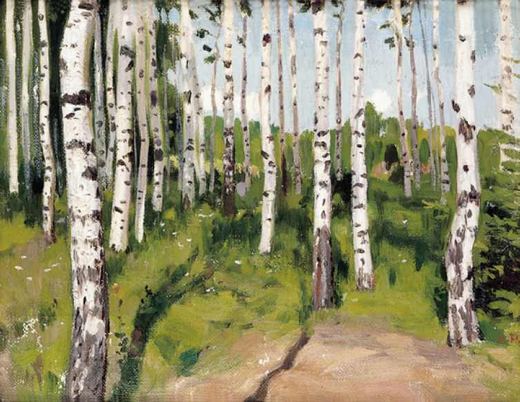
Wald
Arcadij Aleksandrovich Rjlov
1916 · Oil on canvas · 37 x 29 cm
Arkadij Aleksandrowitsch Rylow belongs to the major Russian landscape painters at the threshold between the Silver Age and the early Soviet period. His work combines the school of Arkhip Kuindzhi, a Symbolist understanding of nature and a powerful, almost emblematic landscape language. Rylow painted nature not only as a visible place, but as a carrier of movement, freedom, sound and inner tension. Works such as Green Noise and In the Blue Expanse belong among the best-known images of Russian landscape painting in the early twentieth century. Rylow was born in the Vyatka region and received his artistic training first at the Baron Stieglitz School and later at the Imperial Academy of Arts, where he studied with Arkhip Kuindzhi. This training shaped his sense of light, colour effect and compositional breadth.
Unlike a purely topographical landscape painter, Rylow sought an intensified experience of nature. Wind, water, sky, bird flight and tree crowns become rhythmic elements of a pictorial world that is both realistically observed and symbolically charged. After the Revolution, Rylow remained an important figure in grad artistic life. He taught, participated in artists’ associations and was integrated into the Soviet context as a landscape painter. His ability to make images of nature appear as symbols of awakening, breadth and freedom made his art adaptable to new historical interpretations. Yet it retained a quality that exceeds political readings: Rylow’s landscapes possess lyrical and energetic force generated by colour, movement and atmospheric compression. For I tesori della Russia, Rylow is one of the most important positions in the twentieth-century landscape section.
He connects the great Russian landscape tradition of the nineteenth century with Symbolist and early Soviet modernity. Alongside Levitan, Shishkin, Dubovskoy, Petrovichev or Lagorio, Rylow can help tell the development of Russian landscape as a spiritual image-space: from forest and coast to village and the moving sky of the new century.
Rylow’s pictorial language is dynamic, colour-rich and symbolically charged. Moving skies, flying birds, wind-swept vegetation and a composition that makes nature appear as a field of force are characteristic. His landscapes are not mere views, but images of energy, freedom and poetic experience of nature.
The source list names the Tretyakov Gallery, the Russian Museum, the Kaluga Museum of Fine Arts and the Vyatka Art Museum. For I tesori della Russia, Rylow is a key name in Russian landscape painting between the Silver Age, the Kuindzhi school and Soviet modernity.