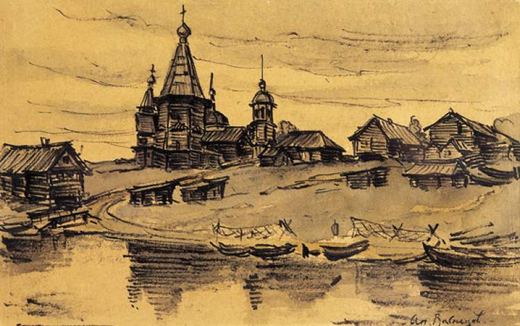
Village on the River in the Arkhangelsk Region
Apollinary Mikhaylovich Vasnetsov
watercolored ink on paper · 23 x 15 cm
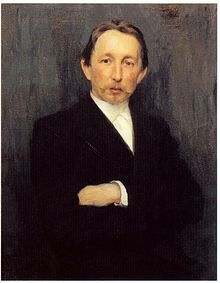
Apollinary Mikhaylovich Vasnetsov is one of the most distinctive artistic personalities in Russian art around 1900. His work unites landscape, historical research, architectural reconstruction and national imagination. While his elder brother Viktor Vasnetsov is associated above all with fairy tale, epic and religious-national monumental art, Apollinary developed a particular form of historical landscape painting. He made old Moscow - its Kremlin walls, wooden buildings, marketplaces, monasteries and city views - into an artistic field of research. Vasnetsov did not receive a strictly academic education in the classical sense. He first learned in the circle of his brother and later came into contact with artists and patrons of the Abramtsevo circle.
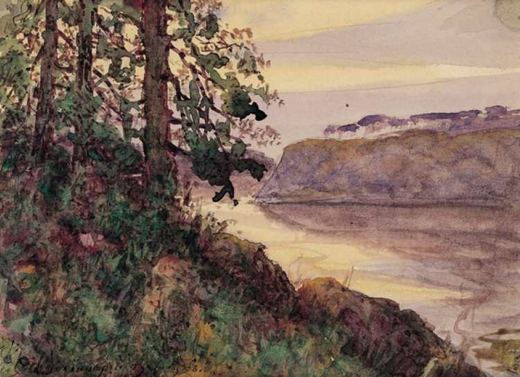
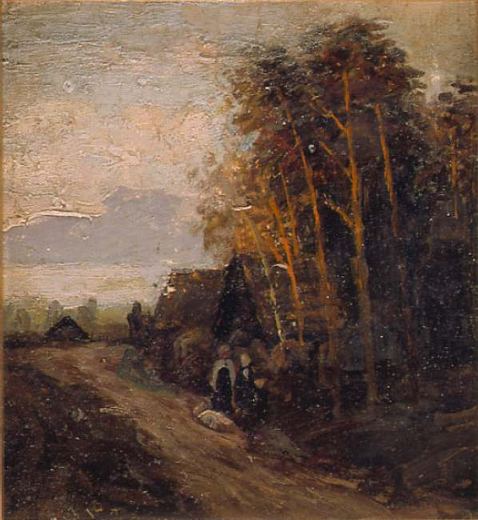
There, around Savva Mamontov, Viktor Vasnetsov, Vasily Polenov and others, artistic modernity met an interest in old Russian culture, folk art and national narrative. This connection shaped Apollinary Vasnetsov's entire oeuvre. In his early landscapes one senses the breadth of northern Russian and Ural nature; later, the focus increasingly shifts to the historical-archaeological reconstruction of Moscow. His significance lies in the fact that he made the past spatially experienceable rather than merely illustrative. His views of medieval Moscow are based not simply on fantasy, but on historical and archaeological knowledge. In this way he created a pictorial form that stands between art, historiography and urban memory. His cityscapes are not cold reconstructions. They possess atmosphere, light, movement and narrative density.
Old Moscow appears as a living stage, a place of trade, power, everyday life and religious order. As a member of the Peredvizhniki and later as a co-founder and leader of the Union of Russian Artists, Vasnetsov stood at an important threshold in Russian art. He shared the realism of the Wanderers, but extended it toward cultural memory and historical imagination. In his Moscow pictures in particular, it becomes visible that Russian art around 1900 did not merely depict social present or landscape, but actively participated in constructing a national historical image archive.
Vasnetsov's visual language combines topographical precision with narrative condensation. In his reconstructions of old Moscow, architecture, street layout and urban panorama are carefully organised. At the same time, he avoids dry antiquarianism. Staffage figures, effects of light, weather and perspective give the scenes an inner movement. The viewer is meant not only to recognise history, but to enter it. His landscapes reveal a related interest in breadth and structure. Nature appears not as private mood, but as a space of historical and cultural experience. Vasnetsov's work can therefore be read as a connection between landscape painting, cultural archaeology and Russian politics of memory.
For I tesori della Russia, Apollinary Vasnetsov is a key name because he carries the collection beyond pure landscape and pure genre painting into the sphere of historical identity. A profile on Vasnetsov allows visitors to see how Russian artists constructed not only nature or people, but also history, city and national memory through painting. His presence in the Tretyakov Gallery and the Russian Museum confirms his position as a museum-established representative of a genuinely Russian historicism.