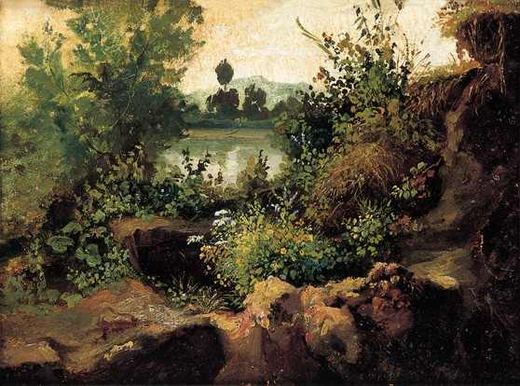
On the Riverbank
Anton Ivanovich Ivanov-Goluboy
1850 · Oil on wood panel · 25 x 19 cm
Anton Ivanovich Ivanov-Goluboy is a moving and art-historically distinctive figure in nineteenth-century Russian painting. He was born in 1818 in the village of Kozakovo in the former Vladimir Governorate as a serf. His path into art did not begin with privileged origins, but with early talent, patronage and contact with the brothers Grigory and Nikanor Chernetsov, important Russian landscape painters and travelling artists. From 1833 onward, Ivanov-Goluboy studied in Saint Petersburg with the Chernetsov brothers. In 1838 he accompanied them on their famous journey along the Volga. This journey was important for Russian art history because it brought together landscape, topography, ethnographic observation and artistic documentation. Ivanov-Goluboy's picture of the Chernetsov brothers' workshop on the Volga barge was shown at the Academy in 1839 and is now considered a valuable document of that undertaking. In 1841, with the support of the Chernetsovs, he was redeemed from serfdom and gained the possibility of continuing to work as a free artist. He was subsequently connected with the Imperial Academy of Arts and received support as a pensioner. In 1846 he travelled to Italy with the Chernetsov brothers. While they returned to Russia in 1848 in response to political events, Ivanov-Goluboy remained in Rome, where he lived until his death in 1863.
Ivanov-Goluboy's work connects Russian landscape experience with an Italian study period and a Romantic-academic pictorial outlook. His landscapes and genre pictures preserve an attentiveness to topographical detail, light and atmosphere without dissolving entirely into academic idealisation. The connection to the Volga is especially important: as a motif, the Volga was a symbolic carrier of Russian vastness, society and national self-observation in the nineteenth century. His surviving oeuvre is limited. Precisely for this reason, the few signed or museum-secured works are especially valuable art-historically. They document not only an artist, but also a social ascent, a context of training and an early form of Russian travel and landscape painting. Art-historical classification: Art-historically, Ivanov-Goluboy belongs to the circle of the Chernetsov brothers and to the Romantic-academic landscape painting of the first half of the nineteenth century. His biography as a former serf also makes him a socially significant artistic figure. The Russian Museum identifies him as a painter, landscape painter and author of genre scenes who came from serfdom, studied with the Chernetsovs, took part in the Volga journey and lived in Italy from 1846 onward.
For I tesori della Russia, Ivanov-Goluboy has particular narrative force. His profile allows Russian art to be shown not only as a history of great institutions, but also as a history of social mobility, patronage, travel and memory. A work by or connected with Ivanov-Goluboy can represent early Russian landscape painting, the Volga myth and the connection between Russia and Italy in an especially compelling way within the collection.