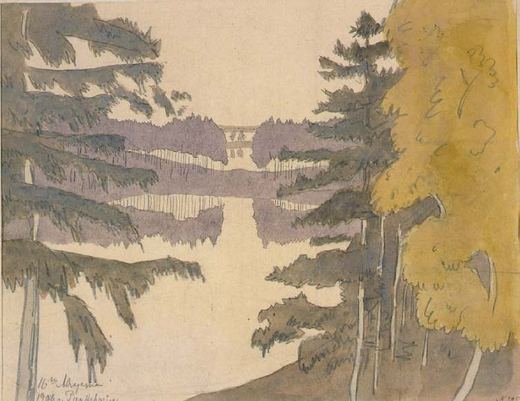
Finnish Landscape at Punkaharju
Anna Petrovna Ostroumova-Lebedeva
1908 · Watercolor on paper · 23 x 18 cm
Anna Petrovna Ostroumova-Lebedeva ranks among the most important women printmakers of Russian modernism and among the decisive renewers of woodcut in Russia. Born in Saint Petersburg in 1871, she received her training first at the Stieglitz School and then at the Imperial Academy of Arts, where she studied with major teachers including Ilya Repin and Vasily Mate. Her career is significant both art-historically and in terms of gender history: she was one of the first women to achieve a professional and internationally visible position in the Russian art world around 1900.
Ostroumova-Lebedeva was closely connected with the circle of Mir Iskusstva, the movement that moved Russian art at the threshold of the twentieth century away from the moral-social programme of the Peredvizhniki and toward a renewed appreciation of style, line, historical consciousness, book art, decoration and artistic individuality. Sergei Diaghilev, Alexandre Benois, Leon Bakst and Konstantin Somov stand for this circle; within it, Ostroumova-Lebedeva brought graphic art to an independent modern language. Her principal subject became Saint Petersburg. In her woodcuts, colour woodcuts and watercolours, the city appears not as topographical illustration, but as an atmospheric body made of water, architecture, bridges, avenues, fog, snow and light.
The clarity of her line, the reduced colour and the controlled rhythm of the surfaces connect Western printmaking, the influence of Japanese colour woodcut and the specific melancholy of Russia's northern capital. Her engagement with Japanese printmaking was not a mere fashion. Like other artists of Mir Iskusstva, she recognised in ukiyo-e an alternative to academic spatial illusion: flat composition, precise cropping, ornamental structure and subtle transitions of colour. She transformed these impulses into a Russian and specifically Petersburg pictorial language. For an international audience, Ostroumova-Lebedeva offers one of the clearest ways to understand the elegance and refinement of Russian modernism.
Her works show that Russian art around 1900 consisted not only of monumental painting or radical avant-garde, but also of an intimate, disciplined and highly cultivated graphic language.
Ostroumova-Lebedeva's pictorial language depends on strict simplification and great sensitivity. Woodcut forces decision: line, surface and contrast must carry what painting might achieve through tonal transitions or atmospheric glazes. This is precisely where her mastery lies. Her city views balance architecture and feeling; they show Petersburg as a historical monument, but also as a fragile apparition transformed by light and season. Art-historically, Ostroumova-Lebedeva stands at a key point of Russian modernism. She connects the revival of original printmaking with the aesthetic programme of Mir Iskusstva and with a specifically urban concept of Russian culture. Her works are held, among other institutions, by the Russian Museum, the British Museum and the Metropolitan Museum of Art, which makes her an internationally accessible position of high rank.
For I tesori della Russia, Ostroumova-Lebedeva is especially valuable because she offers a refined, internationally understandable access point to Russian modernism. Her work communicates elegance, discipline and poetic depth. She is an ideal position for showing a sophisticated public that Russian modern art also developed through print, book culture, japonisme and the atmospheric image of Saint Petersburg.