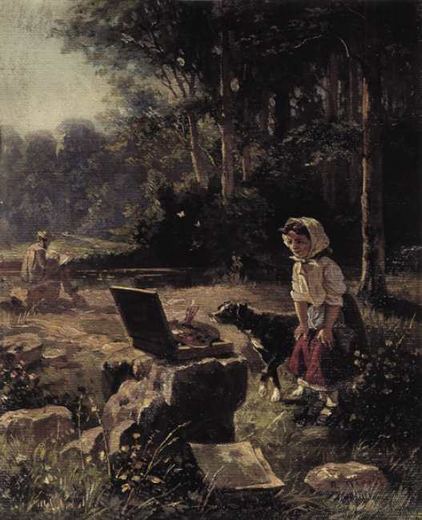
The Palette
Andrei Andreyevich Popov
1890 · Oil on canvas · 20 x 24 cm
Andrei Andreyevich Popov belongs to the generation of Russian genre painters who, in the middle of the nineteenth century, helped establish everyday life as an independent subject of painting. Art historically, he stands between academic training, narrative realism and the growing attention paid to social milieus, character types and popular scenes. While monumental history painting and court portraiture retained considerable weight in Russian art, painters such as Popov sought a more immediate pictorial language: scenes of trade, craft, domestic life and humorously sharpened situations in which social observation and painterly characterization converge. Popov was born in Tula and received his first artistic formation in a provincial painting environment. His academic path led him to the Imperial Academy of Arts in Saint Petersburg.
There he became familiar with the Academy's landscape and history-painting culture while developing a particular talent for the lively staging of ordinary situations. Even his early successes show that Popov was not primarily concerned with idealized beauty, but with character, gesture and psychological legibility. A key work in his career is the composition related to Ivan Krylov's fable Demyan's Fish Soup, which brought Popov attention at the academic exhibition of 1857. The subject allowed him to combine literary humour, physiognomic observation and compositional concentration. This is characteristic of Russian genre painting: the picture does not merely tell a scene, but makes the social roles and temperaments of its figures visible.
Popov's later interest in commercial and everyday scenes, including the milieu of the Nizhny Novgorod Fair, places him within the realist narrative tradition from which a more socially attentive Russian painting would develop over the course of the nineteenth century.
Popov's work is driven by narrative clarity, precision of facial expression and a feeling for the theatrical potential of daily life. His figures do not appear as abstract types, but as actors within socially legible spaces. Colour and composition remain indebted to academic schooling, yet the pictorial effect aims more at vivid intelligibility than at representational grandeur. Popov is therefore an important mediator between the Academy and realist genre painting.
For I tesori della Russia, Popov is particularly valuable as a representative of nineteenth-century Russian genre painting. He opens the view onto the bourgeois and popular dimension of Russian art, a dimension often underestimated beside landscape, history painting and the avant-garde. A work by Popov can be read within the collection as evidence of how Russian painting, long before the Soviet era, made social milieu, everyday life and narrative into subjects of serious art.