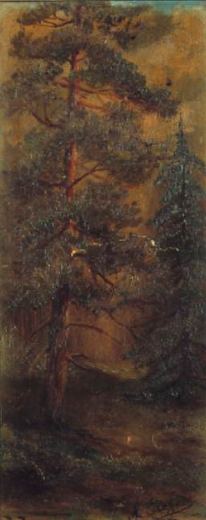
Tree at Sunset
Andrei Afanasyevich Jegorov
Oil on canvas · 18 x 36 cm
Andrei Afanasyevich Egorov is a distinctive figure in Russian-Estonian art history. Born in 1878 near Reval, today's Tallinn, he stands between the art centres of Saint Petersburg and Estonia. His education took him to Saint Petersburg, where he first attended the drawing school of the Society for the Encouragement of the Arts and then studied at the Academy under important teachers such as Ilya Repin and Dmitry Kardovsky. In 1909 he received the status of artist. Egorov's work is closely associated with landscape, rural scenery and atmospheric winter motifs. His paintings often show roads, snow, sleighs, villages and quiet states of nature. These motifs is not understood merely as folkloric; they connect realist observation of Baltic-Russian everyday life with a sensitive treatment of light, cold and season. Winter atmosphere in particular became a recurring hallmark of his pictorial world. After 1921 Egorov lived mainly in Tallinn. He therefore embodies an artistic borderland: he is part of the Russian academic tradition, yet firmly embedded in Estonian art history. Sources describe him as both a Russian and an Estonian painter; this dual orientation is not a contradiction, but an expression of the complex cultural geography of the former Russian Empire. In the Estonian SSR he was recognised as an honoured art worker.
Egorov's painting is shaped by quiet observation and atmospheric concentration. Landscape does not appear in his work as heroic vastness, but as inhabited, often wintry living space. His compositions make use of paths, sleigh motifs and muted colour. The result is a poetic realism that remains close to the Russian landscape tradition while unfolding a clearly Baltic topography and mood. Art-historical classification: Art-historically, Egorov is best understood as a link between Saint Petersburg academic training and Estonian-Baltic landscape art. His work demonstrates how the artistic structures of the Russian Empire continued to resonate in regional and later national art histories. The coexistence of Russian, Estonian and Soviet contexts is preserved carefully in catalogue wording.
For I tesori della Russia, Egorov is important because he extends the collection beyond Russia's narrower borders into the Baltic cultural sphere. He shows how Russian academic education, Baltic landscape and Estonian art history were interwoven. His work can therefore be presented within the collection as an example of imperial and post-imperial cultural entanglement.