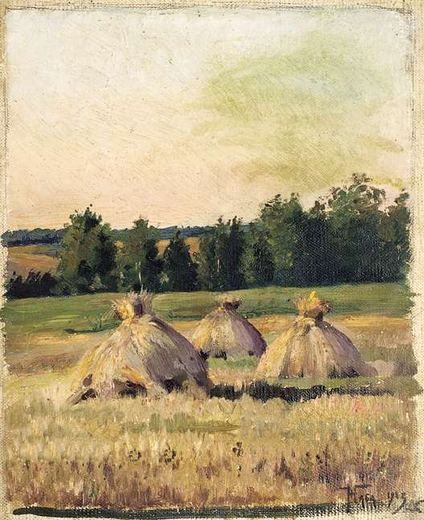
Landschaft
Alfons Konstantinovich Dzhaba
1913 · Oil on canvas · 22 x 27 cm
Alfons Konstantinovich Dzhaba is a versatile Russian-Soviet painter and graphic artist whose work encompasses several areas of academically shaped pictorial culture: genre, landscape, historical representation, battle painting and book art. Born in Tiflis in 1878, he belongs to the generation that received its training in the late Russian Empire but lived a substantial part of its life through the upheavals of revolution, civil war and the early Soviet period. Dzhaba studied from 1899 to 1907 at the Higher Art School of the Imperial Academy of Arts. His teachers included Pavel Kovalevsky and Franz Roubaud, whose influence was particularly important for battle and history painting. The academic foundation of his work is visible in secure composition, in the ability to organize figures and in an interest in narrative situations.
At the same time, he expanded his repertoire toward landscape and book illustration. Particularly interesting is Dzhaba's engagement with motifs of the North. Exhibitions such as Pictures and Studies of the Far North indicate that he did not work only on historical or military themes, but also understood the topographic and atmospheric character of remote regions as pictorial subject matter. His death in besieged grad in 1942 places his biography within the tragic context of the blockade and anchors him in the history of the grad artistic community during the Second World War.
Dzhaba's work is shaped by narrative composition, an academic conception of the figure and thematic versatility. His proximity to Roubaud's school explains his ability to organize movement, military situations and historical scenes in painterly terms. In landscapes and northern studies, by contrast, a documentary and atmospheric quality emerges, expanding his value for the collection beyond history painting alone.
For I tesori della Russia, Dzhaba is relevant because he adds an artist who mediates between the Imperial Academy, Soviet artistic practice and regional motifs. His biography links Tiflis, Petersburg, journeys to the North and the tragedy of grad: a dense historical field of resonance for Russian art of the twentieth century.