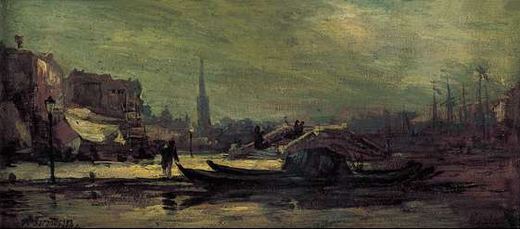
Venice
Alexey Petrovich Bogolyubov
c. 1850 · Oil on wood · 26 x 12 cm
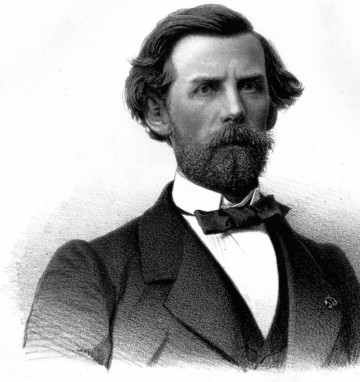
Aleksei Petrovich Bogolyubov was one of the most important Russian landscape and marine painters of the nineteenth century. His work combines the experience of a naval officer with academic training, European travel painting, realistic study of nature and an exceptional public role as patron and museum founder. In Russian art history, Bogolyubov stands between the great tradition of marine painting, the landscape culture of the Peredvizhniki and a European-shaped art of travel, observation and documentation. Bogolyubov was born in 1824 in the Novgorod Governorate and was first educated at the Naval Cadet Corps. This background is decisive for his artistic work. He knew ships, harbours, coasts, weather, fleet movements and maritime technology not merely as motifs, but from direct experience. In 1850 he entered the Imperial Academy of Arts and graduated in 1853 with the Grand Gold Medal.
He then undertook extensive journeys through Europe, especially in France and Germany, where he further developed his painterly language. His art includes seascapes, coastal landscapes, river views, city vedute, travel impressions and historical scenes from the Russian fleet. Unlike purely dramatic marine painters, Bogolyubov was strongly interested in light, atmosphere, topography and the precise appearance of place. He could depict sea battles and naval events, but also quiet harbour scenes, riverbanks, views of Normandy, Swiss and Italian landscapes. This range makes him one of the most cosmopolitan Russian landscape painters of his generation. The Russian Museum emphasises that Bogolyubov was not only a painter, but also a significant personality in the artistic life of his time.
He supported Russian artists in France, worked in the orbit of the Peredvizhniki and was connected with artists such as Repin, Polenov, Vereshchagin and others. His long residence in Paris made him a mediator between the Russian and French art worlds. At the same time, his work remained closely connected with Russia, especially with the history of the Russian fleet and the development of a national landscape art. One of his greatest cultural achievements was the founding of the Radishchev Art Museum in Saratov, considered the first publicly accessible art museum in the Russian provinces. This foundation shows that Bogolyubov understood art not only as individual production, but as a public educational mission. His patronage considerably expands his significance: he was artist, collector, organiser, supporter and mediator.
For I tesori della Russia, Bogolyubov is a high-ranking artist because he connects several central themes of Russian art: sea and empire, travel and Europe, academic painting and realism, artists' networks and museum foundation. His profile makes it possible to explain nineteenth-century Russian art not as provincial, but as international, maritime and institutionally ambitious.
Bogolyubov's pictorial language is shaped by precise observation, differentiated handling of light and a secure sense of atmospheric effect. His marine paintings are technically credible, yet never merely illustrative. Ships, water, sky and coastal architecture become a compositional unity. This combination of factual accuracy and painterly mood distinguishes him from decorative seascape painting. Art-historically, Bogolyubov stands between academic marine painting and realist landscape art. He was connected with the Peredvizhniki, without being reduced to a purely socially critical programme. His international experience made him an important mediator between Russia and Europe. At the same time, as a museum founder, he contributed to the institutionalisation of Russian art beyond the capitals.
For I tesori della Russia, Bogolyubov offers an excellent opportunity to communicate the imperial, maritime and European horizon of Russian art. He shows Russia as naval power, travel culture and art nation at once. Within the collection, his profile can serve as a bridge between Academy, landscape, naval history and public artistic patronage.