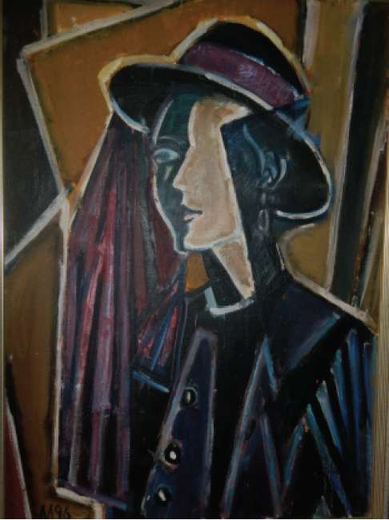
Portrait of a Woman
Alexey / Aleksei Lazykin
1996 · Oil on canvas · 50 x 70 cm
Aleksei Alexandrowitsch Lazjikin is a Russian painter of the generation that emerged from the major Soviet art institutes after the Second World War and sought new paths within figurative painting between academic training, modern form and urban-industrial subject matter. Born in 1928 in Podolsk near Moscow, he studied at the Repin Institute in grad and graduated in 1956 from the studio of Boris Ioganson. He therefore received one of the most prestigious academic educations available in Soviet art. Lazjikin worked across several genres: portrait, landscape, still life and thematic painting. Several sources particularly emphasize his engagement with industry, the cityscape and modern urban experience. These subjects are significant for Soviet post-war art because they visualize construction, technological modernity and the transformation of everyday life.
His work is not placed too quickly under the term nonconformism. The source list connects him with contexts of Russian nonconformist art, but external sources present him more strongly as an academically trained and later internationally active painter with a modern, at times post-Cubist formal language. This tension is productive for the catalogue, but it must be formulated precisely: Lazjikin stands less for open dissidence than for individual painting within and beyond the Soviet academic tradition. His international reception is noteworthy, particularly his connection with Italy, where market and artist sources indicate a dedicated museum or institutional presentation of his work.
For I tesori della Russia, Lazjikin can therefore be read as an example of the later international circulation of Russian art: a Soviet-trained artist whose paintings link motifs of city, industry and still life with a European openness of form.
Lazjikin's work moves between figurative painting and modernized composition. Still lifes and interiors can assume a post-Cubist order; industrial and urban landscapes point to the modern Soviet world of experience. Colour, plane and object are not radically dissolved, but are often structured more strongly than in classical academic naturalism. Art-historically, Lazjikin is considered a representative of late Soviet and post-Soviet painting that is neither fully state-official nor clearly nonconformist. This intermediate position is important for the collection: it shows that Russian art of the late twentieth century does not consist only of clear camps, but of many transitional forms between academy, market, modernity and individual painterly handwriting.
The source list names the Museum of Russian Nonconformist Art, the Garage Museum of Contemporary Art, smaller Russian state museums and private collections in Russia and Europe. These references still be checked on an object-specific basis before being publicly linked to concrete institutions. In the public collection text, however, Lazjikin is presented as an interesting late conclusion to the collection narrative: an artist who carries Russian painting into the period after classical Soviet doctrine and into international collecting contexts. For I tesori della Russia, he functions as a transition into post-war and near-contemporary art, adding city, industry, modern still life and the question of how Russian painting continued after academicism, Socialist Realism and nonconformism.