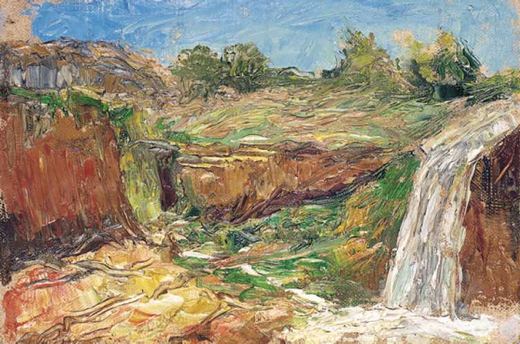
Clay Quarry
Alexander Vasilyevich Skalon
1915 · Oil on canvas · 23 x 15 cm
Aleksandr Vasilyevich Skalon was a Russian artist, art critic and public actor in artistic life whose career extends from the late Imperial period into the Soviet era. He is not among the internationally best-known names in Russian art today, but he is instructive for understanding Petersburg exhibition culture around 1900 and the transitions into early Soviet museum work. His profile connects academic training, participation in artists' societies, critical activity and later work within museum structures. Skalon was born in 1874 and came from the Russian noble Skalon family. From 1894 he studied at the Imperial Academy of Arts in Saint Petersburg. In 1902 he received the title of artist for the painting “In the Village”. This stage anchors him in the late academic tradition, in which genre painting, figure composition, draughtsmanship and realistic choice of motif remained important.
At the same time, Skalon moved within the lively exhibition culture of his period. He took part in exhibitions in the halls of the Academy and is mentioned in the orbit of the Peredvizhniki as well as various Russian artists' and support societies. Skalon is especially interesting as a figure between artistic production and the art public sphere. He was active not only as a painter, but also as an art critic and social participant. Such personalities shaped Russian art culture substantially: they wrote, organised, debated exhibitions, maintained correspondence and mediated between artists, audiences and institutions. His connection with Nikolai Roerich, with whom Skalon was friends and corresponded, points to his integration into the broader Petersburg artistic and intellectual scene.
After the Revolution, Skalon worked in the museum field during the 1920s, including in connection with the Tver Museum Collegium. This phase is especially relevant for a collection because it shows how artists of the old art system were drawn into the new Soviet cultural administration. Museum work, preservation, classification and regional cultural policy became central tasks in the early Soviet years. Skalon therefore stands for the transformation of the artist from Academy exhibitor to guardian and mediator of cultural heritage. His death in 1942 in besieged grad gives his biography a tragic historical dimension. Like many artists and intellectuals of his generation, Skalon experienced the extreme violence of the twentieth century: revolution, civil war, institutional upheaval and finally the Siege of grad.
This historical tension is not melodramatised in a public catalogue, but it is treated with respect. For I tesori della Russia, Skalon is important as a representative of the art culture around 1900 and its institutional continuation. He shows that Russian art history cannot be told only through stylistic revolutions, but also through artists who shaped exhibitions, wrote criticism, helped organise museums and enabled cultural continuity across political ruptures.
Skalon's work is connected with academic training, realist figure and genre painting, and draughtsmanship. His graduation work “In the Village” points to an interest in rural motifs and genre scenes, which continued to matter in Russian art around 1900. Without a full overview of the oeuvre, his pictorial language is not defined too narrowly. Art-historically, his significance also lies in his critical and institutional role. He belongs to those artists whose effect is not to be understood through individual paintings alone, but through participation in the art system. The transition from the Academy to museum work makes him a revealing figure of continuity and transformation within Russian art institutions.
For I tesori della Russia, Skalon makes visible the collection-historical and institutional dimension of Russian art. His profile draws attention to the world of Academy exhibitions, artists' societies, criticism and early museum work. In this way, he complements the great style-forming names with an important layer of the art system itself.