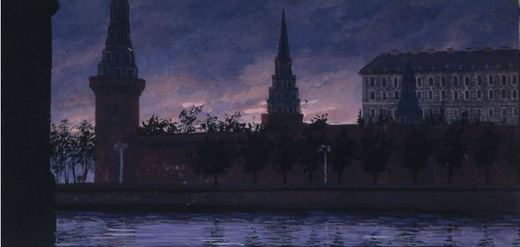
Spring in Moscow
Alexander Nikolayevich Samokhvalov
watercolored tempera on paper · 25 x 12 cm
Aleksandr Nikolayevich Samokhvalov is among the most important artists of Soviet grad art in the twentieth century. His work connects the formal experiments of the post-revolutionary 1920s with the visual language of Soviet Realism and is therefore art-historically complex. Samokhvalov was a painter, graphic artist, monumental artist, book illustrator, theatre artist and designer. He represents a generation that lived through revolution, civil war, hunger, cultural awakening and later ideological canonisation - and developed from these experiences a visual language of its own. Born in 1894 in Bezhetsk, Samokhvalov came to Petrograd/grad and studied in the 1920s at the Higher Artistic-Technical Workshops and the institute connected with the former Academy. His training with Kuzma Petrov-Vodkin was decisive.
Samokhvalov did not simply adopt a style from Petrov-Vodkin; he absorbed an expanded way of thinking about space, body and pictorial order. The famous “spherical perspective”, the clarity of colour and the idea of a spiritually ordered composition had a lasting effect on him. His diploma work “The Washing of the Head” from 1923 is often cited as an early example of this engagement. In the 1920s Samokhvalov moved within the circle of important artist associations such as Krug khudozhnikov and October. These groups searched for a new visual language for Soviet contemporaneity without wholly abandoning the achievements of modernity. In this sense, Samokhvalov's art is not simple propaganda. It contains constructive composition, symbolic elevation, rhythmic treatment of the body and an almost iconic image of the “new human being”.
His figures often appear monumental and at the same time poetically distanced: women workers, sportswomen, young women, Pioneers and construction workers become not only social types, but bearers of a new, almost mythical modernity. His depictions of women in labour and sport became especially famous, including the series of Metrostroevki and the painting “Girl in a T-shirt”. These works belong to the key images of the Soviet 1930s. They show a body no longer represented in aristocratic or bourgeois terms, but conceived as active, public, athletic and productive. Samokhvalov succeeded in making this ideological figure pictorially compelling: clear silhouettes, strong colour, rhythmic surfaces and an upright pictorial structure give his figures dignity and energy.
The Russian Museum describes Samokhvalov as one of the greatest Soviet painters of the twentieth century and links his name with the establishment of the image of a new human being. This assessment indicates his central role within Soviet art history. At the same time, his art is not reduced to state commission. It contains an independent painterly intelligence that emerges from Russian modernity and develops further under the conditions of official art. For an international collection of Russian art, Samokhvalov is especially valuable because he exemplifies the difficult relationship between the legacy of the avant-garde, the grad school and Socialist Realism. His work helps prevent Soviet art from being read simply as a break with modernity. Instead, it reveals the complex transformation of modern forms into new political and social images.
Samokhvalov's visual language is marked by clear composition, a plastic conception of the body, rhythmic surfaces and frequently luminous, controlled colour. Figures are monumentalised, but not made heavy. They appear as modern icons: concentrated, frontal, active and at the same time surrounded by a peculiar poetic distance. The connection between Petrov-Vodkin's spatial thinking and Soviet themes is a core of his art. Art-historically, Samokhvalov stands between Russian modernity and Socialist Realism. He preserves elements of the avant-garde - constructive order, symbolic elevation and new images of the body - and carries them into official thematic fields. His work is therefore a key to grad art of the 1920s and 1930s and to the question of how modernity and ideology became intertwined in Soviet art.
For I tesori della Russia, Samokhvalov is a central artist for communicating Soviet modernity. He shows that the collection does not stop at pre-revolutionary art, but also addresses the aesthetic and political reconfiguration of the image in the twentieth century. For demanding viewers in particular, his profile can clarify the difference between mere state art and artistically ambitious Soviet image-making.