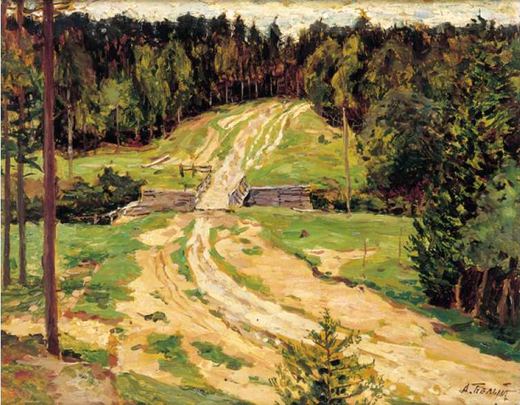
The Road through the Forest. Bridge
Alexander Fyodorovich Bely; Aleksandr Bely
Oil on panel · 46 x 37 cm
Aleksandr Fjodorowitsch Belij is a representative of Russian and early Soviet painting whose work stands between academic landscape training, southern Russian origins and later Soviet subject matter. He is not one of the great canonical names, but as a professional painter and teacher of the late nineteenth and early twentieth centuries he is relevant for a differentiated collection. His profile shows how the academic landscape tradition continued into the period after 1917 and developed under changed themes. Belij was born in the Odessa region or in the Kherson Governorate; sources variously give 1874 or 1875. He studied at the Odessa Art School and, from 1894, at the Imperial Academy of Arts in Saint Petersburg. Around 1900 he received an artist's degree for landscapes such as Twilight in Crimea and Morning in the Caucasus.
His training with, or in the circle of, landscape teachers such as Aleksandr Kiselyov anchored him in an academically grounded, nature-oriented painting in which Crimea, the Caucasus and southern landscapes played important roles. Later, Belij also worked as a teacher and was active in institutions of artistic education. In the Soviet period, his thematic range expanded; alongside landscapes, revolutionary subjects are also mentioned. This development is characteristic of many artists of his generation: they came from the Academy of the Russian Empire, retained their painterly formation and at the same time adapted to new social expectations and exhibition formats. Belij therefore stands for continuity and adaptation, not for radical stylistic breaks. For I tesori della Russia, Belij is important as a supplementary collection position.
He can mark the bridge between academic landscape painting, southern motifs of the Russian Empire and early Soviet painting. In a sophisticated art catalogue, he is classified precisely, soberly and respectfully: not as an avant-gardist, not as a primary master, but as a professional painter whose work makes visible the breadth and institutional depth of Russian art production around 1900.
Belij's work is shaped by academic landscape training and solid realist painting. Crimea, the Caucasus and southern Russian motifs play an important role in the surviving training works. Later, Soviet and revolutionary subjects also appear. His art-historical significance lies in the continuity of Academy, teaching and landscape tradition beyond 1917.
The source list names the Russian Museum, the State Historical Museum in Moscow, the Tver Regional Gallery, art museums in Russia and Ukraine and private collections. For I tesori della Russia, Belij is suited as a supplementary artist for academic landscape, southern Russian art and early Soviet continuities.