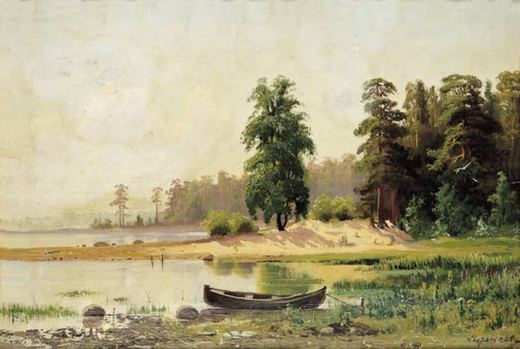
Pine Grove by the Lake
Alexander Eliseevich Voronkov
Oil on canvas · 51 x 33 cm
Aleksandr Elisejewitsch Woronkow is a source-critical entry within the list of I tesori della Russia. The name is not treated with the same certainty as the canonical artists in this block. In the source list he is explicitly recorded as an unattributed artist. For a public catalogue, it is therefore essential not to create artificial certainty. The profile is understood as a reviewed working attribution until the work, signature, provenance and, where relevant, Academy records have been clearly compared. Under the name Aleksandr Elisejewitsch Woronkow, Russian auction and reference contexts identify an artist born in 1838 who is said to have studied as a free auditor at the Imperial Academy of Arts in Saint Petersburg.
For the years 1858 to 1865, an academic training or participation is mentioned; in 1864 he is said to have received two second-class silver medals, and in 1865 the rank of non-class artist. Works such as Landscape, Portrait of the Brother and a view from the surroundings of Saint Petersburg are cited. Later teaching activity in Vilna is also mentioned. These details are plausible, but they are not secured at the level of major museum biographies. Art-historically, such an artist would be situated in the sphere of academic landscape and portrait practice of the 1860s. He would stand for the broad layer of trained painters, draughtsmen and drawing teachers who did not enter the canon of Russian art, but who helped sustain the visual and pedagogical system of the nineteenth century.
For collections, precisely this level can be interesting when a concrete work is of quality and has secure provenance. The art-historical value then lies less in the name than in the connection between work quality, dating, Academy context and regional teaching or exhibition history. For I tesori della Russia, Woronkow is therefore not presented as a main artist, but as a specialist position requiring verification. A public-facing text explains the possible classification without hiding uncertainty. In high-level art circles, precisely this transparency appears professional: a collection that marks problematic attributions cleanly shows more competence than a collection that covers thin source evidence with inflated language.
If the attribution is confirmed, Woronkow would be classed within academic Realism and the landscape/portrait practice of the mid-nineteenth century. The decisive factor is not canonical art-historical standing, but the concrete verification of the work: painting quality, signature, material, dating, provenance and possible connection with the Imperial Academy.
The source list names Woronkow with the birth year 1838 and explicitly notes him as an unattributed artist. For I tesori della Russia, this entry is treated as an internal review and provenance case. Public presentation is advisable only if the specific collection work can be clearly connected with the documented Academy artist.