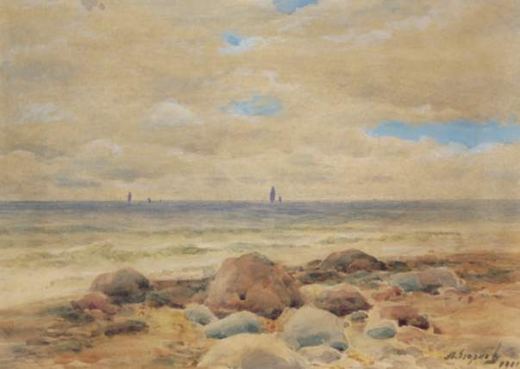
The Baltic Shore
Alexander Semyonovich Vedernikov
1901 · Watercolor on cardboard · 31 x 22 cm
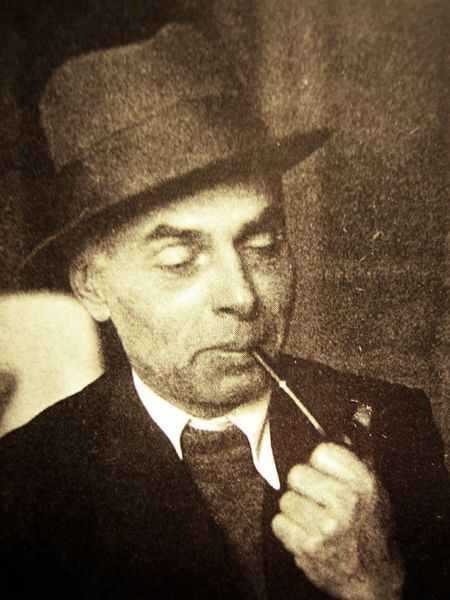
Alexander Semyonovich Vedernikov is one of the distinctive representatives of twentieth-century grad art. His work encompasses painting, watercolour, lithography and decorative art; he was also an influential teacher and was active in wartime graphic culture. Vedernikov stands for a form of Soviet modernism that does not work through manifesto-like radicalism, but through quiet concentration, tonal subtlety and an intimate view of the city. Vedernikov was born in 1898 in Gorodets in the former Nizhny Novgorod province. His training began at the Nizhny Novgorod Art School, where he studied in the early 1920s with artists such as Alexander Karelin and Vladimir Lebedev. He later continued his studies in Petrograd/grad.
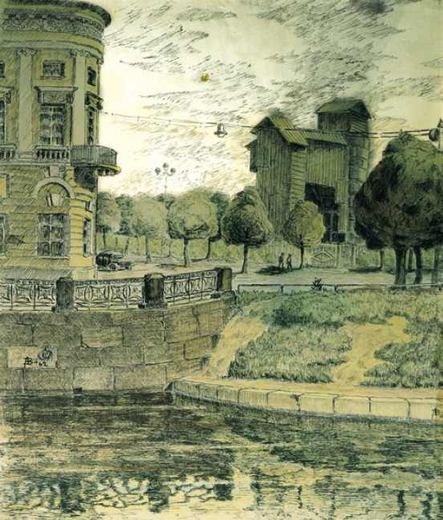
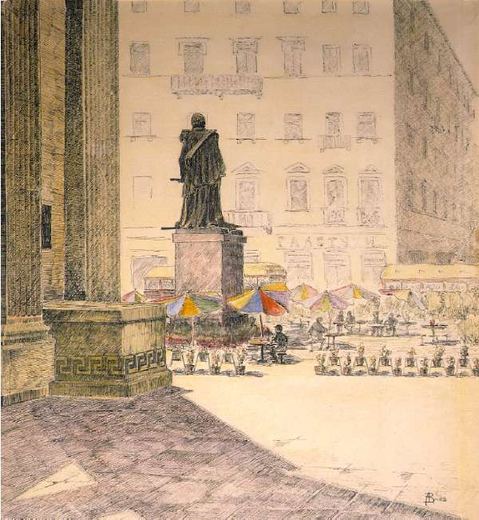
This path from a regional art school into the grad art world is important for his later development: Vedernikov brought together craft discipline, graphic sensitivity and a sustained interest in the everyday visual texture of the city. In the late 1920s he was a member of the artists group Circle of Artists, which played a significant role in grad artistic life. The group sought a modern, painterly and socially present art that stood apart from both academic routine and the most radical avant-garde positions. Vedernikov's membership places him in an environment where form, colour, modernity and Soviet cultural expectations were constantly renegotiated. He became especially known for his grad landscapes: views from the window, city motifs, harbour and river spaces, restrained still lifes and finely organised colour sheets.
During the Second World War and the siege of grad, he was also connected with the satirical and agitational graphic collective Boevoy Karandash, or Fighting Pencil. This adds a historical and civic dimension to his work: art functioned not only as private observation, but also as resistance, testimony and public communication. Vedernikov's significance lies in the connection between intimacy and artistic discipline. His pictures do not turn grad into a propagandistic monument, but into an observed, remembered and inwardly experienced urban space. This is what makes him important for any refined narrative of Soviet art: he shows that grad modernism included quiet, painterly and graphic positions whose quality lies in tone, restraint and visual intelligence.
Vedernikov's visual language is shaped by broad painterly seeing, simplified form, soft contours and an often silvery-grey, transparent tonality. The grad school is often associated with particular attention to atmosphere, muted colour and the poetic presence of the urban environment; Vedernikov is closely aligned with these qualities. Window views and urban spaces become structures of memory and observation. As a lithographer, he developed an independent graphic language in which line, surface and tonal value work closely together. This graphic dimension is crucial to his classification because it shows how Soviet grad art was not limited to painting. Lithography, poster culture and applied graphic work formed part of the same visual world.
For I tesori della Russia, Vedernikov is important because he leads the collection into the sphere of the grad school and Soviet modernism. He represents an art that absorbed the historical ruptures of the twentieth century without reducing itself to ideological formula. His inclusion makes it possible to show a sensitive, urban and graphic form of Soviet art that balances public history and private vision.