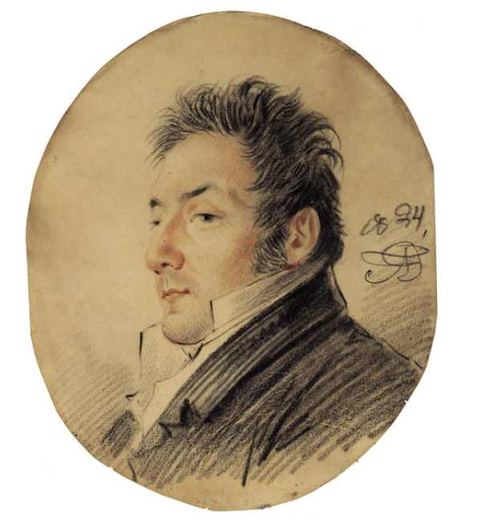
Portrait of an Aristocrat
Aleksandr Osipovich Orlovsky / Aleksander Orłowski
1824 · Pastel on paper · 21 x 21 x 0 cm
Aleksandr Osipovich Orlovsky, also known internationally as Aleksander Orłowski, is a key figure at the intersection of Polish and Russian art around 1800. Born in Warsaw in 1777 and deceased in Saint Petersburg in 1832, he brought a Polish-inflected culture of drawing, Romantic mobility and a pronounced gift for observation into the artistic milieu of the Russian Empire. Orlovsky was trained in Warsaw in the circle of Jan Piotr Norblin de la Gourdaine and received further impulses from Marcello Bacciarelli, printmakers and miniaturists. This training was decisive for his later work: Norblin's combination of Realism, fantasy, caricature and free drawing remained perceptible in Orlovsky's art. In 1802 he came to Saint Petersburg, where he drew military uniforms and parade scenes for Grand Duke Konstantin Pavlovich and quickly moved within aristocratic, military and intellectual circles. His oeuvre includes horsemen, Cossacks, soldiers, market scenes, caricatures, portraits, Orientalising motifs and lithographic series. He is regarded as one of the early pioneers of lithography in the Russian Empire. The importance of this is difficult to overstate: lithography enabled a new dissemination of images and helped bring types, costumes, military scenes and urban observations into a broader visual public sphere.
Orlovsky's strength lies in line. His drawings appear swift, lively and precise at the same time; they capture posture, movement, character and social role with great economy. Riders and Cossacks do not appear as rigid figures of representation, but as dynamic bodies in space and motion. His caricatures and representations of types likewise show a sharp eye for gesture, clothing and physiognomy. Thematically, he connects military culture, street life, the world of horses and Romantic imagination. This mixture is precisely what makes him so interesting for Russian art history: he shows the empire not only as an official system of rule, but as a moving visual world of soldiers, merchants, carriages, riders, ethnic groups, costumes and borderlands. Art-historical classification: Art-historically, Orlovsky stands at the beginning of a more modern, mobile visual culture in the Russian Empire. He is both a Polish Romantic and a Russian court and society draughtsman, both painter and pioneer of printmaking. Works by Orlovsky are held, among other institutions, by the Russian Museum, the Tretyakov Gallery, the State Historical Museum in Moscow, the National Museum in Warsaw and the Metropolitan Museum of Art.
For I tesori della Russia, Orlovsky is a highly interesting position because he makes visible the multinational structure of the Russian Empire. His art opens the view onto Poland, Petersburg, the military, Cossack culture and early printmaking. He is particularly suitable for showing a demanding audience that Russian art history is not monolithic, but consists of cultural transitions, imperial movements and international artistic biographies.