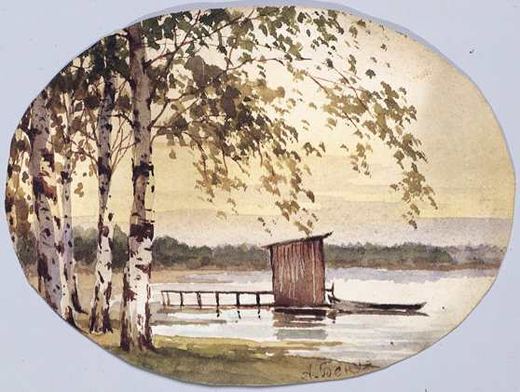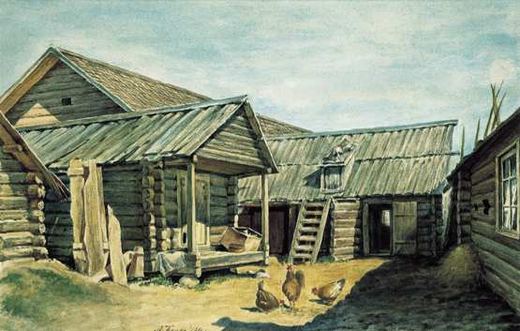
The Three Hens
Alexandre Benois; Alexander Benois
1880 · Watercolor on paper · 36 x 23 cm
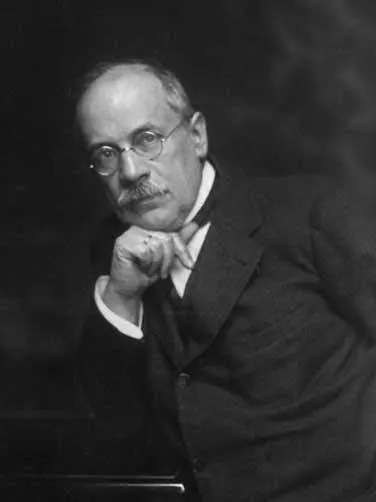
Aleksandr Nikolayevich Benois is one of the central figures of Russian art around 1900. He was not only a painter and draughtsman, but also an art historian, critic, stage designer, museum professional and one of the most important intellectual forces behind Mir Iskusstva, the World of Art movement. Few artists of his generation embody as clearly the connection between artistic practice, historical reflection and curatorial consciousness. Benois understood art not as an isolated object, but as part of a comprehensive cultural history in which architecture, book, theatre, costume, collection and memory are linked. His artistic formation is closely tied to Saint Petersburg and to the educated, internationally oriented culture of the Benois family.
This background shaped his view of the eighteenth century, Versailles, courtly culture, classical architecture and the aesthetic power of historical reconstruction. In his watercolours, stage designs and illustrations, history appears not as dry documentation, but as a poetically staged pictorial space. His works for Pushkin’s The Bronze Horseman and his designs for the Ballets Russes show how Benois joined literary, historical and scenic imagination into a modern visual language. Within Russian art history, Benois stands for a conscious departure from the exclusively socially critical narrative art of late Realism. The artists of Mir Iskusstva sought a refined, European-educated art that took elegance, decoration, historical memory and stylistic self-reflection seriously. Benois was not merely a participant, but a theorist and mediator.
His writings, exhibitions and museum activities helped shape the understanding of old and new art in Russia. He is therefore both artist and interpreter of Russian modernity. For I tesori della Russia, Benois is of the highest rank because he places the collection within the context of the Silver Age, Russian theatrical modernism and the intellectual art culture around 1900. His work shows that Russian art consists not only of Realism and the avant-garde, but also of a highly reflective culture of memory, theatre and historical style. A Benois connection gives a collection immediate proximity to the internationally important circles around Diaghilev, Bakst, Somov and the Ballets Russes.
Benois’s pictorial language is shaped by historical distance, finely balanced composition, literary atmosphere and decorative intelligence. He frequently works with stage space, architecture and layers of memory. His art is not loudly revolutionary, but cultivated, learned and visually powerful: it transforms history into aesthetic presence.
The source list names the Hermitage, Tretyakov Gallery, Russian Museum, Musee d’Orsay, Metropolitan Museum, Nationalmuseum, National Museum in Warsaw and the National Gallery of Armenia. For I tesori della Russia, Benois is an internationally weighted reference artist who connects the collection to the art and theatre history of European modernism.