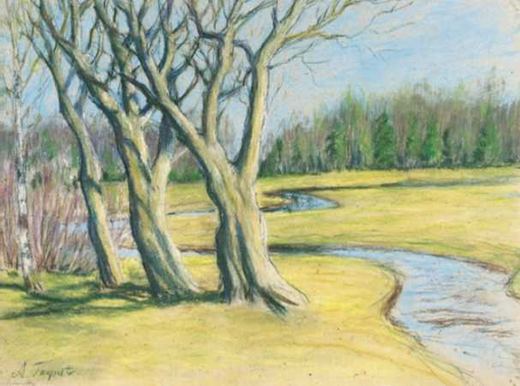
Spring Day
Alexander Fyodorovich Gausch / Hausch
Pastel on paper · 37 x 28 cm
Alexander Fyodorovich Gausch is a multifaceted artist of Russian art between the turn of the century, Petersburg modernism and Soviet reorganisation. He was a painter, graphic artist, teacher, exhibitor, museum worker and at times also active in a theatrical context. His work connects landscape, still life and decorative sensitivity with the networks of Russian art around 1900, especially the circle of Mir Iskusstva and the artists' associations of the early twentieth century. Born in Saint Petersburg, Gausch first received his training at the Drawing School of the Society for the Encouragement of the Arts. In the 1890s he studied with Pavel Chistyakov and at the Higher Art School of the Imperial Academy of Arts under Alexander Kiselyov. This education combined academic security with openness to modern painterly and decorative questions.
From 1900 onward, Gausch regularly took part in exhibitions. He was a co-founder of the New Society of Artists and was later connected with various artists' groups, including the Union of Russian Artists, Venok, the Society named after Kuindzhi, the Society of South Russian Artists and Mir Iskusstva, of which he became a member in 1916. These networks are decisive for his classification. Gausch does not belong to the radical avant-gardists, but he moved within that broad zone of Russian modernism in which landscape, decoration, stage, still life and urban culture were closely interwoven. A particular aspect of his biography is his activity as a preserver and mediator. From 1907 to 1920 he worked as curator or custodian at the Museum of Old Petersburg.
This connection to urban memory and the cultural heritage of Petersburg corresponds to an art that often stands between observation of the present and remembrance. Later, Gausch was active in southern art centres, taught in Sevastopol and at the Odessa Art Institute, and spent his final years in Simferopol. His biography therefore reflects the geographical shift of many Russian and Soviet artists from the imperial centre to regional art milieus. His paintings and graphic works, including landscapes, still lifes and decoratively conceived scenes, reveal a sensitive treatment of colour, surface and atmosphere. Titles such as Poplars, Peacocks at the Fountain and Landscape with Rainbow indicate an eye for nature, ornament and luminous mood.
Gausch is thus an important representative of a cultivated, less clamorous modernism that worked not through rupture, but through refinement, organisation and aesthetic mediation.
Gausch's artistic character lies in the connection between landscape observation, decorative order and an often light, colour-sensitive manner of painting. His pictures avoid pathetic monumentality. They work with atmosphere, rhythm and a cultivated relationship between surface and motif. His proximity to Mir Iskusstva explains the interest in decorative effect, in historical and urban memory and in the connection between free art and applied fields. At the same time, he preserved a solid academic foundation. This makes his work especially interesting for collections that wish to show not only the extremes of Realism and Avant-Garde, but also the differentiated in-between spaces of Russian modernism.
For I tesori della Russia, Gausch is particularly valuable because he connects the collection with the networks of Russian modernism around 1900. He stands for Petersburg culture, exhibition associations, museum consciousness, southern Russian art milieus and the union of landscape, still life and decorative modernism. His presence allows a sophisticated narrative beyond the great individual geniuses: Russian art appears here as a system of schools, associations, cities, museums and aesthetic transitions.